
Two Effective Punctuation Marks in TOEFL Writing: Colon and Semicolon
How to Ace TOEFL Writing?
TOEFL is an English proficiency test, so its primary purpose is to evaluate a test taker’s language skills. Writing, of course, is no exception.
This means that your writing performance is evaluated largely based on the quality of your language rather than the originality of your ideas. In other words, unique or highly creative content itself plays a limited role in scoring.
This stands in clear contrast to school writing, where original ideas are often valued more highly and minor grammatical errors may be overlooked.
To summarize, if you want to score well on TOEFL Writing, you should focus on producing clear, general content while demonstrating a wide range of vocabulary and grammatical structures. The goal is to show your linguistic proficiency, not to present unique or personal insights.
Effective Expressions: Colons and Semicolons
Once you master the use of colons and semicolons, these punctuation marks are not difficult to embed into your writing. However, they are considered advanced grammatical features. As a result, using them accurately and effectively can contribute to a higher writing score.
Below are the basic rules and common uses of these punctuation marks.
| Punctuation | Use | Explanation | Example |
|---|---|---|---|
| Colon | Introducing a list | Used to present items that explain or complete the preceding clause | The guide covers three areas: scheduling, documentation, and follow-up. |
| Introducing details | Used to add clarification or specific information | One issue remains: the lack of clear instructions. | |
| Semicolon | Replacing a conjunction | Used to connect closely related independent clauses | The meeting was delayed; several participants arrived late. |
| Separating complex list items | Used to separate items that already contain commas | The event includes speakers from Tokyo, Japan; Paris, France; and Berlin, Germany. |
From here, we’ll discuss how to use these punctuation marks correctly and effectively in TOEFL writing.
Common Rule for Colon and Semicolon Use
One important rule when using both colons and semicolons is that what precedes these punctuation marks must always be a complete sentence. In other words, the clause before a colon or semicolon must be able to stand on its own grammatically.
Let’s first look at an example of a grammatically correct use of a colon and semicolon.
Colon:
I have read your guide intended for new employees. However, I found room for improvement: structure and terminology.
As you can see, the clause that precedes the colon is an independent clause, meaning it is a complete sentence. The colon is then used to introduce specific items that clarify what “room for improvement” refers to.
Semicolon:
Thank you for arranging the kick-off party for the upcoming conference. The atmosphere of the reserved restaurant was great; however, some of my colleagues mentioned that there wasn’t enough food and drink for 30 people. For the next standing buffet, I recommend preparing more refreshments so that everyone will be satisfied.
In this example, the semicolon is used before the adverb “however,” followed by a comma. We will discuss this usage in more detail in a later section, but for now, focus on what precedes the semicolon. As required, a complete sentence, or an independent clause, comes before it.
As you can see from both the colon and semicolon examples, the universal rule is the same: these punctuation marks must always follow a complete sentence.
Colons

Colons are one of the punctuation marks which is expressed as (:). Though it may have many functions in real life, you should just remember two of the grammatical uses:
- Introducing a list of items related to the preceding clause
- Introducing a detail of the preceding clause
Introducing a List of Items
This use is straightforward: write a complete sentence, and then introduce a list of items that explain or complete the preceding clause.
Although the structure itself is simple, many learners mistakenly place a colon after a non-independent clause. In such cases, the clause before the colon cannot stand on its own, which makes the sentence ungrammatical. The following are common examples of incorrect usage:
Both sentences are incorrect because a colon must be preceded by a complete sentence.
In the first example, “I like animals because of” is not an independent clause. The prepositional expression “because of” requires a noun phrase to complete its meaning, so the structure before the colon is grammatically incomplete.
The latter sentence is also incorrect for a similar reason. The linking verb are requires a complement to form an independent clause. Without completing this structure, the sentence cannot stand on its own before the colon. For example, if the sentence is written as follows, it becomes grammatical:
Some of the important features of the system are highly visible: processing speed and usability.
In this case, the clause before the colon is a complete sentence, and the colon is correctly used to introduce specific details.
Introducing a Detail
Perhaps this use of a colon is more difficult than simply introducing a list. When a colon is used to introduce details, the information that follows must clarify or explain the preceding clause.
If the information after the colon is unrelated or does not clearly explain the previous statement, the meaning of the sentence becomes unclear. For this reason, you should always make sure that what comes after the colon directly supports or elaborates on the clause before it. For example, the following sentence uses a colon incorrectly because the relationship between the two parts is unclear:
This sentence is grammatically correct but inappropriate because the detail that follows “my family members gather at home” doesn’t clearly explain the preceding clause, “Many people in my country celebrate the day.” The second part describes a personal action rather than providing information that applies to many people in general.
The following revision correctly introduces a relevant detail after the colon:
Many people in my country celebrate the day: houses and stores decorate their exterior walls and doors with colorful ornaments.
Semicolon
You should also remember two common uses of semicolons. Appropriate and grammatical use of semicolons can improve the overall quality of your writing, especially in TOEFL, where demonstrating a variety of grammatical structures is important.
Below are two common uses of semicolons:
- Substituting for a conjunction
- Separating complex items in a list
Substituting for a Conjunction
In English, a conjunction is typically required when connecting two complete sentences, or independent clauses. Failing to do so results in grammatical errors known as comma splices or run-on sentences. For this reason, you should avoid writing sentences like the following:
This sentence contains a comma splice. The first independent clause, “My colleagues are eager to participate in the networking event,” and the second independent clause, “they are willing to expand their business network,” are incorrectly joined by a single comma. Remember that a comma alone cannot connect two independent clauses.
To make the sentence grammatical, you can add a semicolon before the adverb and a comma after it:
My colleagues are eager to participate in the networking event; they are willing to expand their business network.
Using a semicolon alone is effective; however, when it’s combined with an adverb and a comma, the expression becomes more sophisticated and is highly valued in TOEFL writing.
TOEFL Effective Expression: Semicolon–Adverb–Comma
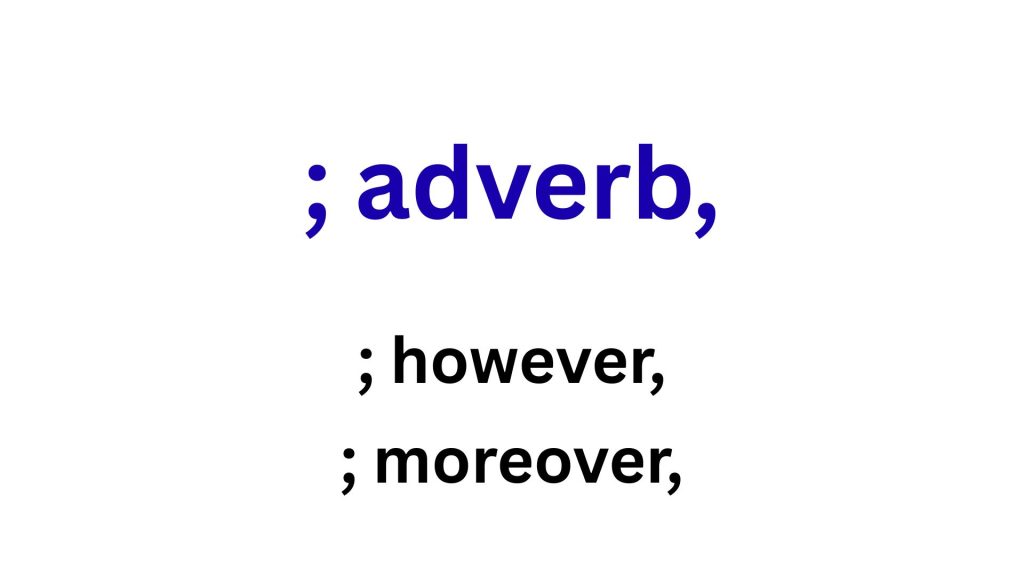
One advanced structure that can improve the quality of your TOEFL writing is the semicolon–adverb–comma pattern. This structure allows certain adverbs to function as connectors between two independent clauses when they are used together with a semicolon and a comma.
One of the most common examples is “; however,”. By nature, “however” is an adverb, not a conjunction, so it cannot directly connect two independent clauses on its own. As a result, using it with only a comma creates an ungrammatical sentence. For example, the following sentence is a common ungrammatical use of the adverb:
This sentence contains a comma splice. The two independent clauses are joined by a comma and an adverb, which is not sufficient to form a grammatical connection. To make the sentence grammatical, you can add a semicolon before the adverb and a comma after it:
I personally think that your presentation was excellent; however, some of my colleagues didn’t seem so.
I strongly recommend that you remember this structure, as it is considered an advanced grammatical pattern and can significantly improve the quality of your writing.
Special Structure: Using an Adverb as a Connector
You can use the following structure to allow an adverb to function as a connector between two independent clauses:
Semicolon + Adverb + Comma
I strongly recommend that you remember this structure, as it is considered an advanced grammatical pattern and can significantly improve the quality of your writing.
Separating Complex Items in a List
Finally, a semicolon can be used to separate complex items in a list. Here, complex items refer to groups of words that already contain commas. If such items are also separated by commas, the list can quickly become difficult to read.
Consider the following example, where complex items are incorrectly separated by commas:
In this sentence, each item consists of a city name followed by a comma and its country name. When commas are used both within each item and between items, the boundary between city–country pairs becomes unclear.
Although the example above includes well-known place names, this structure can cause serious confusion when the locations are less familiar. In such cases, using semicolons to separate each item makes the list much clearer.
To avoid such ambiguity, we use semicolons to separate each complex item in a list:
I have lived in several countries, Indiana, America; London, England; and Saskatchewan, Canada.
Because each complex item is separated by a semicolon, the boundary between items becomes clear, making the list much easier to read.
