
Practicing Note-Taking with a Short Announcement at a Science Field Station
Effective Note-Taking for Speaking Section Part 1
The TOEFL Speaking section, renewed in 2026, has undergone a complete change. The new format consists of two tasks: “Listen and Repeat” and “Take an Interview.”
On this page, you will focus on effective note-taking for Speaking Section Part 1. In this task, you listen to a short audio prompt and then repeat it exactly as you heard it. Paraphrasing or altering expressions is not allowed. Because of this strict requirement, note-taking must aim to capture every word, not just the general meaning.
We provide practice materials specifically designed for note-taking in Speaking Section Part 1. However, repeatedly practicing note-taking without understanding how to take effective notes is inefficient. Before practicing on your own, it is important to examine a model example and understand what makes note-taking both accurate and time-efficient.
Suppose you are asked to take notes word by word for the following announcement. How would you take notes in a limited amount of time?
Model Note for New TOEFL Speaking Section Part 1
Effective note-taking relies on the strategic use of abbreviated words and symbols. Below is a model note taken for the following listening sentence.
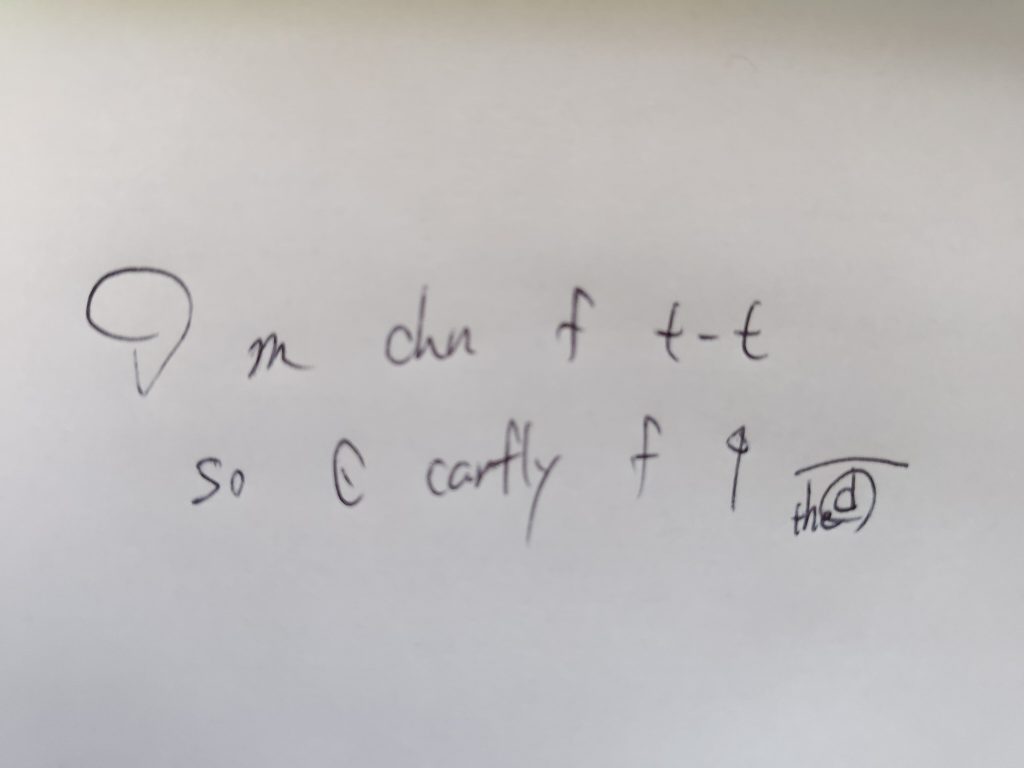
- Ch: children
- m: must
- rem: remain
- ad + roof symbol: with adults
- roof symbol: while
- eye symbol: viewing
- intec: intractive
- exib: exhibition
As you can see, every word in the sentence is represented, but none of them are written in full. Grammatical words such as with and while are replaced with symbols, while content words are shortened to a form that is easy to reconstruct later.
Now it’s your turn.
Try to jot down every word in the sentence you hear. Do not write full spellings, and make sure to use symbols whenever possible. The goal is not neat handwriting, but fast and accurate reconstruction of the original sentence.
Note-Taking Practice
In this practice, the prompts are centered around announcements related to outdoor science field station.
Practice 1
Transcription and model note
Please gather near the entrance.
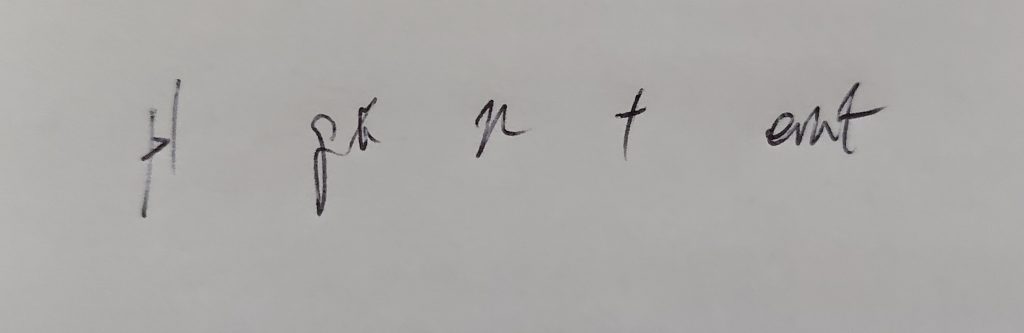
Each abbreviated word and symbol corresponds to the following ideas:
- pl: please
- gt: gather
- n: near
- t: the
- ent: entrance
For Speaking Section Part 1, one of the most important purposes of note-taking is to keep track of word count and the presence of articles such as a, an, and the. Because this task requires you to repeat the utterance exactly as it was spoken, even small grammatical elements like articles and prepositions cannot be omitted.
For example, to avoid missing the article “the” in the utterance, you can mark it simply as “t” in your notes. Although this may seem insignificant, such small markers are crucial for accurate reconstruction. Missing or adding an article results in an incorrect repetition, so even minimal notation can make the difference between a correct and an incorrect response.
Practice 2
Transcription and model note
Safety instructions will be shared shortly.
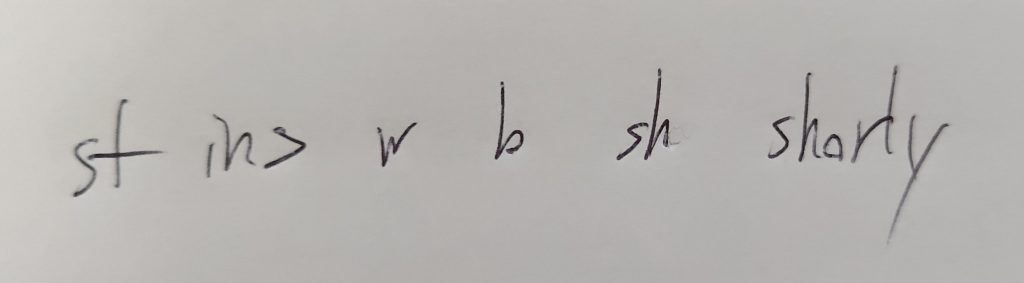
Each abbreviated word and symbol corresponds to the following ideas:
- sf: please
- ins: follow
- w: staff
- b: instructions
- sh: shared
- shorly: shortly
Leaving clear markers for singular and plural forms is extremely helpful when reconstructing an utterance. In the model notes, the plural marker “s” is added to “in”, which represents instructions. This small but meaningful marker prevents confusion between “instruction” and “instructions” and helps you reproduce the sentence accurately.
That said, there is one mistake in the sample note. Writing “shortly” in full was unnecessary and inefficient. This happened simply because there was enough time, and the word was written without strategic consideration. In practice, it should be abbreviated to something like “shly” or replaced with a simple symbol that you personally associate with “shortly.”
Practice 3
Transcription and model note
Closed sections are clearly labeled and monitored for ongoing scientific work.
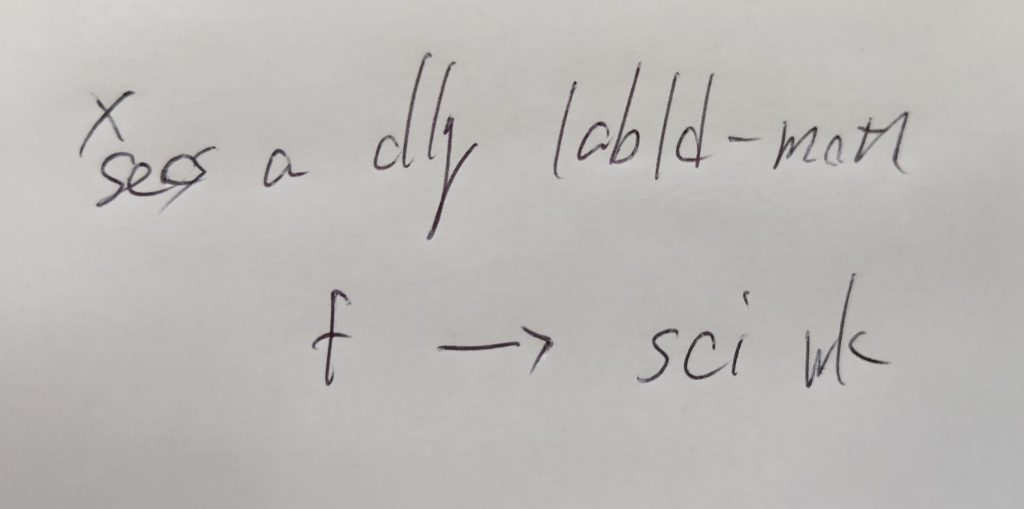
Each abbreviated word and symbol corresponds to the following ideas:
- X secs: Closed sections
- a: are
- clly: clearly
- labld – mon: labeled and monitored
- f: for
- →: ongoing
- sciwk: scientific work
Remember that note-taking in Speaking Section Part 1 is not only about capturing content words such as nouns and verbs. Its primary purpose is to help you reproduce the sentence exactly, word by word. This means that even small grammatical elements, including articles and prepositions, must be noted.
That is why the article “a” and the preposition “for” are explicitly marked in the notes. Because human memory tends to retain the beginning and the end of an utterance more easily, abbreviated forms like “X secs” and “sciwk” are sufficient to recall the full expressions they represent.
Also, whenever possible, using symbols is more efficient than writing words. Symbols are faster to draw and reduce cognitive load. In the sample notes, the adjective ongoing is replaced with a right-arrow symbol (→), which effectively preserves the meaning while saving time.
