
Study Strategies for the New TOEFL Reading (2026)
New TOEFL Reading Format
As of January 21, 2026, the TOEFL will undergo a major revision. Although the test format has been adjusted several times in the past, the upcoming change represents the most significant overhaul to date. All sections, Reading, Listening, Speaking, and Writing, will be substantially revised, with the Reading section seeing especially notable changes.
In the traditional TOEFL Reading section, test takers were presented with long academic passages and asked to answer questions based on those texts. In contrast, the new TOEFL Reading section is divided into three distinct parts:
- Complete the Words
- Read in Daily Life
- Read an Academic Passage
Because the reading formats have changed so extensively, it is essential to adjust study strategies to match the new test structure. In this article, we will introduce effective approaches for each part to help you prepare for the updated TOEFL format.
Below is a brief overview of the differences between the traditional and the new TOEFL Reading sections.
| Traditional TOEFL Reading | New TOEFL Reading (Jan 21, 2026-) | |
|---|---|---|
| Overall Structure | Single-format academic reading | Three-part structure |
| Question Types | Academic passage questions only | Multiple formats targeting different reading contexts |
| Passage Types | Long academic passages | Academic and non-academic texts |
| Adaptivity | No adaptive modules | Adaptive modules (Module 1 → easier or harder Module 2) |
Adaptivity and Two Modules
In addition to changes in question formats, another major update to the TOEFL Reading section is the introduction of an adaptive testing system.
Under the traditional TOEFL format, all examinees were required to answer the same set of reading questions, regardless of their individual reading proficiency. While this approach may appear fair, it placed a heavy burden on test takers whose reading skills were below the level expected by the TOEFL.
The new TOEFL Reading section, however, adopts an adaptive structure. Test takers complete two modules, and the difficulty of Module 2 is determined by their performance in Module 1.
This type of adaptive testing is also used in other standardized exams, such as the SAT and the GRE. As a result, advancing to the more challenging second module is an important factor in achieving a higher score.
Accuracy Required to Advance to the Harder Module 2
Although the TOEFL does not officially disclose the accuracy threshold required to advance to the more difficult Module 2, insights from other adaptive tests such as the SAT and the GRE suggest that the cutoff is often around 60%.
Based on this pattern, it is reasonable to assume that a similar benchmark may be applied to the TOEFL. For this reason, test takers should aim to answer well over 60% of the questions correctly in Module 1.
Experience with other adaptive testing systems suggests that advancing to the harder Module 2 generally places test takers in a higher performance range than those who remain in the easier module, often exceeding the midpoint of the score scale.
In practical terms, this corresponds to the middle range of the band score scale (around 3.0–3.5), although the TOEFL does not officially specify score thresholds for module placement.
Not All Parts Appear in Reading Module 2
This information may be especially helpful if you haven’t taken the test yet. Note that the question types you encounter in Module 1 and Module 2 are different. In addition, the question types in the easier Module 2 and the more difficult Module 2 are also different.
You can expect the following patterns:
- Easier Module 2: Part 1 and Part 2
- Difficult Module 2: Part 1 and Part 3
The easier Module 2 includes “Complete the Words” and “Read in Daily Life,” whereas the more difficult Module 2 includes “Complete the Words” and “Academic Reading.”
This means that, depending on your target score, you need to decide strategically which parts to study. For example, if you are aiming for a score above 4, spending too much time on Part 2, “Read in Daily Life,” may not be the best use of your time because it doesn’t appear in the more difficult Module 2. In that case, it would be wiser to focus on Part 1 and Part 3.
Effective Study Strategies for Each Part
In this section, we examine effective study strategies for each part of the Reading section. The discussion follows this order:
- Part 1: Complete the Words
- Part 2: Read in Daily Life
- Part 3: Read an Academic Passage
Recommended Study Order: Part 3, Then Part 2, and Finally Part 1
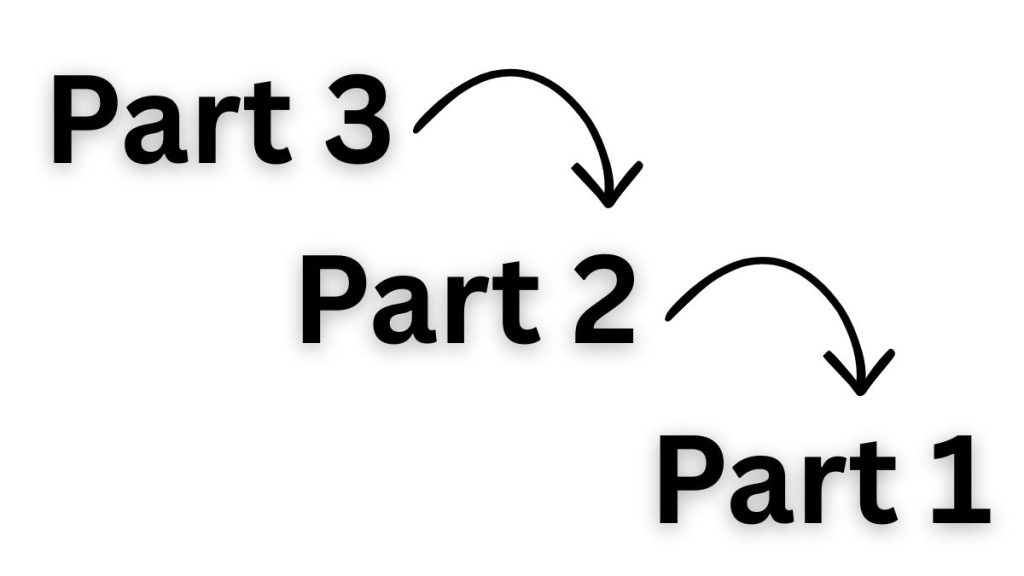
The order in which you prepare matters. If you have sufficient time, you can study all three parts in a balanced way. However, when preparation time is limited, it is more effective to begin with Part 3, move on to Part 2, and finish with Part 1.
Beginning with Part 3 is efficient because it indirectly supports preparation for Part 1 as well. Part 1 requires you to complete academic passages by supplying appropriate words, which demands understanding of academic vocabulary and structures. By working through Part 3 first, you naturally expand this vocabulary, making Part 1 easier to handle later. This approach helps you study more efficiently within a limited time.
Part 2, by contrast, is closely tied to everyday situations and does not typically require extensive preparation. Becoming familiar with the question format and reviewing common daily expressions is often enough to perform well on this part.
Moreover, if you aim to score above 4, or 80 on the traditional score scale, you need to advance to the more difficult Module 2. In that case, spending too much time on Part 2 is not the wisest use of your time because it doesn’t appear in the more difficult Module 2. To prepare effectively for that module, you should focus more on Part 1, “Complete the Words,” and Part 3, “Academic Reading.”
Part 1: Complete the Words
Before we begin, let’s first try this question format.
In modern science, the universe is understood as the entirety of space, time, matter, and energy. Current cos_ _ _ _ _ _ _ _ _ _ research suggests that it began as an extremely dense and hot state and has been con_ _ _ _ _ _ _ _ to expand ever since. As a r_ _ _ _ _, distant galaxies appear to be moving away from one another, a phenomenon that provides observational support for this theory. De_ _ _ _ _ _ major advances in technology, many questions re_ _ _ _ _ unanswered, particularly those concerning dark matter and dark energy, which are thought to p_ _ _ a major role i_ shaping the large-scale structure of the universe.
Answer
In modern science, the universe is understood as the entirety of space, time, matter, and energy. Current cosmological research suggests that it began as an extremely dense and hot state and has been continuing to expand ever since. As a result, distant galaxies appear to be moving away from one another, a phenomenon that provides observational support for this theory. Despite major advances in technology, many questions remain unanswered, particularly those concerning dark matter and dark energy, which are thought to play a major role in shaping the large-scale structure of the universe.
Passages in Part 1 are always academic in nature. You are required to fill in missing words in the text, with the first few letters of each word provided as a clue. Your task is to complete each word so that the passage reads naturally and logically.
The missing words can range from prepositions to vocabulary commonly used in academic writing. So, a solid understanding of academic topics, academic vocabulary, and grammar is essential for performing well in Part 1.
Basically, there are four main ways to determine the missing words:
- Rely on your intuition:
This is the fastest way to identify missing words. Because each blank shows how many letters are missing, there is a good chance that your answer is correct if the word you come up with matches the required number of letters. If no answer comes to mind right away, try one of the following three strategies. - Use grammatical analysis to narrow down word type:
When trying to guess a missing word, grammar can help you reduce the number of possible answers. For example, if a subject and a verb are already in place, a blank between them may accept an adverb, especially when the sentence is already complete. In that case, the blank is more likely to need an optional modifier than a core sentence element. - Look for paraphrased parts:
Some missing words correspond to ideas that are paraphrased elsewhere in the passage. If you can identify those paraphrased parts, they may give you a clue to the missing words. - Look for repeated words:
Some words, especially difficult ones, may appear again later in the passage. So, if you are not sure what word should fill a blank, one useful strategy is to skip that part for the moment, continue reading, and then come back to it later.
In the following section, we will look at effective ways to study for this part, as well as common mistakes to avoid when preparing for the test.
Getting Full Marks on Module 2 Part 1 Is Extremely Important
In the more difficult Module 2, there are 15 questions in total, and 10 of them come from Part 1. Compared with the vocabulary and grammar used in Part 3, “Academic Reading,” the language in Part 1 tends to be more straightforward.
If you prepare effectively, Part 1 can become a major scoring opportunity. Because it makes up most of the questions in the module, getting all 10 questions correct can have a substantial impact on your overall Reading score. Of course, you still need to perform well on Part 3 to raise your score further, but that part contains only 5 questions.
Although both parts matter, Part 1 deserves special attention because it contains more questions. Also, getting 10 out of 10 correct is naturally more demanding than getting 5 out of 5 correct. However, if you can perform very strongly on Part 1, you will have a much better chance of reaching a higher Reading score.
We offer a wide range of resources to help you prepare for Part 1 of the TOEFL Reading section. Each question is designed to closely resemble the actual TOEFL questions in both appearance and format.
- Test1. Psychology (Intermediate)
- Test2. Archeology (Intermediate)
- Test3. Economics (Intermediate)
- Test4. Astronomy (Intermediate)
- Test5. Biology (Intermediate)
- Test6. European History (Difficult)
- Test19. Seismology (Difficult)
- Test20. Dendrochronology (Intermediate)
- Test21. Palynology (Intermediate)
- Test22. Urban Planning (Intermediate)
=>More Questions Available Here
Don’t Simply Remember Words Commonly Used in Part 1
Although it may seem counterintuitive, simply memorizing words that frequently appear in Part 1 is not an effective study strategy. While intensive vocabulary study using word lists or vocabulary books can be helpful to some extent, the words tested in Part 1 are highly contextual. This means that understanding how each word is actually used in academic passage is far more important than knowing its definition in isolation.
Also, the range of possible vocabulary tested is extremely broad. Memorizing individual words does not necessarily translate into better performance. For example, a test passage might require you to complete a phrase such as “cosmological research.” This kind of term is highly specific, and simply memorizing it in advance is impractical and unlikely to be useful.
A more effective approach is to expand your vocabulary through academic reading, rather than focusing on vocabulary itself. Even when preparing intensively for Part 1, it is important to use study materials that provide sufficient background context. Doing so allows you to build both vocabulary and subject knowledge, which ultimately leads to stronger performance on this section.
Study Using Traditional TOEFL Reading Passages
For Part 1, studying vocabulary in context is far more effective than simply memorizing individual academic words. Reading academic passages also helps you become familiar with common academic expressions and finer grammatical features, such as the appropriate use of prepositions.
From this perspective, reading academic passages of sufficient length is highly recommended. One useful resource is textbooks designed for the traditional TOEFL. Because the former TOEFL Reading section consisted of long academic passages, working through these materials allows you to build academic vocabulary, gain background knowledge across disciplines, and develop sensitivity to grammatical patterns commonly used in academic writing.
One recommended resource is the official TOEFL textbooks published by ETS.


Using TOEFL textbooks for the new format is a good way to practice academic reading, but the passages in the new test tend to be shorter and easier.
For that reason, it can be helpful to read texts that are a little more difficult than those on the actual exam, as long as they have a similar style and format.
In that sense, traditional TOEFL practice books may be more useful for learners at this stage.
Understanding Background Knowledge in Academic Fields
While in-depth knowledge of each academic discipline is not strictly required, having a solid background can greatly help you navigate both Part 1 and Part 3 of the Reading section.
For example, memory is a common topic in psychology. Knowing that human memory systems are broadly divided into short-term memory and long-term memory allows you to quickly understand the main idea of a passage. Even when these concepts are explained using complex language and the details are difficult to follow, background knowledge can help you fill in the gaps and maintain overall comprehension.
We also offer a range of practice questions for Part 1. These questions are designed to help you build both academic vocabulary and background knowledge at the same time.

Part 2: Read in Daily Life
If you are familiar with daily expressions, perhaps this is the easiest part in TOEFL. Unlike traditional TOEFL questions, question format in Part 2 is more similar to that of TOEIC.
Materials you see in Part 2 are variable in text types, ranging from email to brochure. The following question is one that you will encounter in TOEFL Reading part 2.

(1) What happens if a company requests a schedule change three days before training begins?
A. The training will automatically switch to an online format.
B. The discount will no longer apply.
C. Additional charges may apply.
D. The training will be canceled without a refund.
(2) What restriction is mentioned regarding the promotional discount?
A. It applies only to on-site training sessions.
B. It is unavailable for international companies.
C. It cannot be used together with certain pricing arrangements.
D. It requires approval from the corporate services team.
Answers
(1) C
(2) C
Don’t Rely on Real-Life Materials for Study
Although this section is called “Read in Daily Life,” using random real-life materials is not an effective way to prepare. The texts that appear on the TOEFL follow highly consistent patterns rather than reflecting everyday reading in a natural setting.
These materials almost always contain key pieces of information, such as event dates, updates, instructions, or reminders. Because the question formats in Part 2 are built around these recurring patterns, simply reading real-life content does not fully prepare you for the test.
Instead, it is more effective to use textbooks or practice materials that are specifically designed with these patterns in mind. Doing so allows you to focus on the information the test is actually assessing.
Prepare Part 2 Using TOEIC Part 7 Single-Passage Questions
Though it’s different test, TOEFL Part 2 and TOIEC Part 7 are similar in their formats. So, if you want to extensively practice Part 2 reading, using TOEIC materials is one of the best solutions.
However, be careful that half of the TOEIC Part 7 questions are double or triple passage-format, which won’t appear on TOEFL. So, make sure to use the first half of TOEIC Part 7 questions, which are single-passage format.
You can purchase TOEIC textbooks from ETS official website.

You can also prepare for TOEFL Part 2 using the resources available on our website.
Part 3: Read an Academic Passage
This part is similar to the Reading questions found in the traditional TOEFL. You will read an academic passage and answer several questions based on its content.
Although the question formats closely resemble those of the conventional TOEFL Reading section, the passages are shorter, typically about one third to one half the length of the former reading test format.
Below is an example of questions that reflect the new test pattern.

Highly Recommended to Start with This Part
As explained above, it is best to begin your preparation with Part 3. Both Part 1 and Part 2 require an academic vocabulary, and a strong understanding of academic topics will make it much easier to handle passages in these parts.
One of the most effective ways to build both skills is to practice reading traditional TOEFL Reading passages. Because these materials consistently focus on academic topics, they allow you to expand your academic vocabulary while deepening your subject knowledge at the same time.
We also offer mock Academic Reading questions on this website.
