
Preparing for the New TOEFL Speaking (2026): Using Dictation and Shadowing
New vs. Conventional TOEFL Speaking Section
Among the four sections, the Speaking section has undergone the most drastic change in the revised TOEFL. While some elements of the traditional format remain in other sections, the Speaking section has been completely redesigned. As a result, strategies used for the conventional TOEFL Speaking section are no longer effective.
The new TOEFL Speaking section consists of two parts:
- Part 1: Listen and Repeat (7 questions)
- Part 2: Take an Interview (4 questions)
In total, you will answer up to 11 questions within 8 minutes. This makes a clear understanding of the test format especially important. It is also important to note that no preparation time is provided for individual questions in the Speaking section.
Below is a summary of how the TOEFL Speaking section has changed in the new format.
| Aspect | Conventional TOEFL Speaking | New TOEFL Speaking (2026) |
|---|---|---|
| Overall Structure | 4 tasks with integrated and independent speaking | Listen and Repeat + Take an Interview |
| Number of Questions | 4 questions | 11 questions (7 + 4) |
| Time Management | Longer responses with preparation time | Rapid responses, no preparation time |
| Required Skills | Reading + Listening + Speaking | Listening + Speaking |
Don’t Start Off by Practicing Speaking Section
Whether you live in an English-speaking country or not, it is generally ineffective to begin TOEFL preparation with the Speaking section. In practice, the Speaking section is best focused on the last stages of preparation.
This recommendation is not based solely on personal experience; it follows from a clear learning principle. Success on the TOEFL depends largely on maintaining a balance between receptive vocabulary (what you can understand through reading and listening) and productive vocabulary (what you can actively use in speaking and writing).
This principle is especially important in the Speaking section. Even fluent speakers can receive lower scores if their responses rely mainly on basic or casual vocabulary rather than precise, academic language.
So, if you feel that your vocabulary needs improvement, it is best to focus on the Reading section first.
Part of Receptive Vocabulary Goes to Productive Vocabulary
One important fact is that the size of receptive vocabulary matters when expanding productive vocabulary.
Since a part of receptive vocabulary is converted to productive vocabulary through output training, it is efficient to first develop the receptive vocabulary, and then move to expanding productive counterparts.

With this in mind, you may realize that prioritizing Reading and Listening sections (input) is important because these two sections are efficient when developing the receptive vocabulary, especially reading section.
When Should You Start Preparing for the Speaking Section?
Reaching the following milestones is a good indicator that you are ready to focus on the Speaking section. These benchmarks are intended for test takers aiming for a total score of 90 or higher (Band Score 4.5). If your target score is lower, you may begin Speaking preparation somewhat earlier.
- Reading 25 (Band score 5)
- Writing 23 (Band score 4.5)
Scoring at or above these levels in Reading and Writing suggests that you have developed sufficient receptive vocabulary and productive vocabulary. At this stage, the next priority is often improving fluency in using that productive vocabulary, which is the core focus of the Speaking section.
When practicing for the Speaking section, make a conscious effort to use formal expressions that feel less comfortable or less fluent at first, as these are the expressions that most effectively raise your Speaking score.
Now, let’s go over effective preparation strategies for Speaking Parts 1 and 2.
Part 1: Listen and Repeat
In this part, you will hear a sentence and repeat it exactly after a beep. While the sentence is played, a visual prompt will appear to help you understand the situation in which the utterance is made.
Let’s try a practice question using this format.
Honestly, this task does not directly reflect real-world speaking ability. Listen and repeat is not a skill commonly used in everyday conversation, and simply being a fluent English speaker doesn’t necessarily provide a strong advantage in this test format.
That said, there are two effective ways to prepare for this part:
- Dictation
- Shadowing
Both methods are effective for improving short-term retention and accurate reconstruction of spoken language. These techniques are widely used in interpreter training and are well suited to the demands of the Listen and Repeat task.
Dictation

Dictation is a practice method in which you write down exactly what you hear. You are not allowed to change word order or rephrase expressions.
Ideally, you should aim to write everything down in a single listen. However, during practice, it is perfectly acceptable to replay the audio multiple times until you can accurately transcribe every word.
Let’s try one. The audio you hear is designed that resembles to those you will hear in the actual new TOEFL speaking section part 1.

This type of dictation practice helps improve your ability to retain spoken information accurately. One challenge in the revised TOEFL Speaking Part 1 is reproducing the exact wording you hear, not just the general meaning. If this skill feels unfamiliar, targeted dictation practice can be especially effective.
On this website, we provide dictation materials specifically designed to match the topic range and difficulty level of the new TOEFL Speaking Part 1.
Shadowing
Shadowing is another training method widely used in interpreter education. In this practice, you speak along with the audio, reproducing the speaker’s words as closely and as quickly as possible.
Unlike dictation, shadowing does not require you to store the entire sentence before producing it. However, it still relies on very short-term auditory processing, so it is not accurate to say that retention plays no role at all. Instead, shadowing primarily strengthens real-time processing, fluency, and listening accuracy.
Unlike dictation, shadowing does not require you to store the entire sentence before producing it. However, it still relies on very short-term auditory processing, so it is not accurate to say that retention plays no role at all. Instead, shadowing primarily strengthens real-time processing, fluency, and listening accuracy.
Because fluency is a key factor in TOEFL Speaking scores, shadowing is considered an effective and practical study strategy, especially for improving smooth, uninterrupted speech.
Remember that going through both dictation and shadowing in the sequential order boosts the study productivity, allowing you to improve both retention skills, fluency, as well as learning expressions.
Effective Note-Taking
Another important factor that boosts your performance in the Listen and Repeat task is effective note-taking. Although a visual prompt appears during this part, it does not help much for two reasons.
First, the visual prompt only supports your understanding of the situation. It does not help you reproduce the exact wording of the utterance. Second, in this task, you must repeat the sentence word for word. Recreating the message using different expressions is not allowed.
Because Speaking Part 1 requires you to listen to an utterance and repeat it exactly, visual aids that merely provide contextual information are of limited value. Instead, mastering effective note-taking techniques is far more important for accurately retaining and reproducing the sentence you hear.
Use Symbols and Shortened Words for Note-Taking
If you currently take notes using fully spelled words, there is room for improvement. That approach may work in school classes or academic lectures, where missing a small portion of the content does not affect overall understanding. However, Listen and Repeat requires a very different set of skills.
In this task, you must accurately remember up to about 15 words and repeat them exactly. No substitution or rephrasing is allowed. While writing down every word in full might seem ideal, most test takers cannot write that quickly. Focusing too much on writing one word can also cause you to miss the next one.
To solve this problem, it is effective to use symbols and abbreviated forms when taking notes. These allow you to capture the structure and key expressions of the sentence without losing focus on listening.
Suppose you need to repeat the following sentence. You could take notes like this:
Please double-check your name tag information before entering the room.
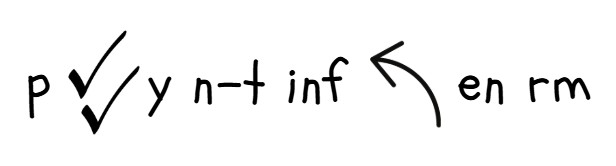
As you can imagine, drawing a symbol is much faster than writing out a full word. Therefore, substituting words with symbols whenever possible is an effective note-taking strategy. As you can imagine, drawing a symbol is much faster than writing out a full word. Therefore, substituting words with symbols whenever possible is an effective note-taking strategy.
Using symbols in this way allows you to record information quickly while keeping your attention on the audio, which is essential for success in the Listen and Repeat task.
Part 2: Take an Interview (4 questions)
In Part 2, an interviewer appears on the screen to simulate an interview setting. The interviewer asks a total of four questions, and each question becomes progressively more challenging.
For each question, you are given 45 seconds to respond, with no preparation time. Because there is no planning phase, it is important to begin speaking immediately and continue until the time runs out. While it is acceptable to use the full time, ending your response clearly and naturally is recommended.
There are several points to consider if you want to score high in this part:
- Formal vocabulary
- Diverse expressions
- Diverse grammatical construction of sentences
- Appropriate length
- Accurately answering to the prompt
- Fluency
Since TOEFL is a test to evaluate one’s English proficiency, how unique and inspiring the response is don’t affect the score much. Indeed, one of the highly graded response is one with general idea but contains called good language use (vocabulary, grammar, and fluency).
Here is a mock test for TOEFL Speaking Section Part 2.
As you can imagine from the lack of preparation time, the questions in this part are designed to be straightforward. As long as you are familiar with common topics, you generally don’t need much time to respond to each question.
Again, the originality of your response is not a major factor in scoring. What matters more is your ability to respond immediately, using variety of expressions, smooth fluency, and natural English. Clear and confident delivery is far more important than presenting a unique or creative idea.
Keep Your Response Concrete and Avoid Abstract Topics
Here’s a simple question: which is easier to keep talking about, a concrete topic or an abstract one?
For most people, concrete topics are much easier. They allow you to come up with ideas quickly and maintain fluency without hesitation. For example, consider the topic of a future dream. When you are asked to talk about your own dream, the topic feels manageable because it is personal and specific. You already have experiences, emotions, and details you can draw from.
In contrast, a question such as “What is one benefit of having a future dream?” is more abstract. It requires you to generalize, explain concepts, and organize ideas logically, which is much harder to do under time pressure.
In interview-style speaking tasks, you should rely as much as possible on personal experiences, concrete facts, or familiar situations. If you drift into abstract reasoning, keeping the conversation going for 45 seconds without preparation becomes extremely challenging. Staying concrete makes your response both easier to produce and more fluent.
Even when a question asks about an abstract idea, such as the benefits of having a dream, you should briefly state the general benefit and then quickly shift to a personal experience as supporting evidence. This approach helps you maintain fluency and provides clear, concrete content to talk about.
Sample Response
Having a future dream gives people clear direction and motivation. When you have a goal, it becomes easier to make daily decisions and stay focused. For example, when I decided that I wanted to study abroad, I became more serious about improving my English. Even when studying felt difficult, that dream helped me stay motivated. A future dream doesn’t guarantee success, but it gives purpose to your efforts and helps you move forward with confidence.
Pretend to Be Someone Else
Although it may feel strange at first, this strategy is actually one of the most effective ways to handle Speaking Section Part 2. Some interview questions are much easier to answer from the perspective of a college student or a recent graduate.
For example, if you are asked about the advantages of a liberal arts education, answering as a high school student can be challenging. Liberal arts programs are typically part of college-level education, so it’s difficult to speak convincingly without that context.
However, if you imagine yourself as a recent college graduate, you can naturally explain how a liberal arts program helped you develop practical skills, such as communication, critical thinking, or leadership. This approach makes it much easier to produce a fluent and concrete response.
Below is a sample response to the question:
“What do you think about the effectiveness of liberal arts programs in shaping one’s career?”
I think liberal arts programs can be effective in shaping one’s career, especially in the long term. They don’t train students for one specific job, but they build transferable skills. For example, when I studied liberal arts subjects like history and philosophy, I learned how to analyze information and communicate ideas clearly. Those skills later helped me adapt to different academic and work situations. So while the benefits may not be immediate, liberal arts programs can support flexible and sustainable career development.
