
The Difference Between Simple Past and the Perfect Tenses
Three Common Tense Forms
In English, tense shows when something happens or what time period a sentence refers to. In this article, we will focus on three common tense forms:
- Present tense: used for facts, habits, and general truths
- Simple past: used for finished actions in the past
- Perfect forms: used to show a relationship between one time point and another
Many learners find the difference between the simple past and perfect forms difficult because both can refer to past situations. However, the key difference is that the simple past presents a past event as complete, while a perfect form connects it to another point in time, such as the present or another past moment.
Choosing the appropriate tense form is important, especially in situations where clear and accurate expression is required.
Now, let’s first review the uses of the simple past and the perfect tense, and then look at the core difference between them.
Simple Past
The simple past is used to describe actions or events that were completed in the past. Its main focus is the past action itself, not its connection to the present or the duration of the action.
I opened the door for you.
This sentence tells us that the speaker opened the door at some point in the past. What matters here is the completed action. The present condition of the door is not the focus of the sentence. It may still be open, or it may no longer be open, but the sentence doesn’t tell us that directly.
Meaning of the Simple Past
The main focus is the completed action in the past. Its connection to the present and the duration of the action aren’t the main concerns.
Perfect Tense
The perfect tense is often one of the most confusing parts of English grammar for learners. One reason may be that the word “perfect” doesn’t clearly suggest the actual function of this tense. In other words, the meaning of the perfect tense can’t be understood simply from its name.
So, let us explain this grammar as simply as possible. First, note that perfect tense forms can be divided into two major types:
- Present perfect
- Past perfect
Understanding this distinction is important because, although these two forms share the idea of relating one time point to another, they are used in different ways.
Present Perfect
The present perfect is formed with “has/have + past participle,” such as “has finished” or “have studied.”
The present perfect tense is used to show that a past action or state is connected to the present in some way. This relationship is often illustrated with the timeline below.
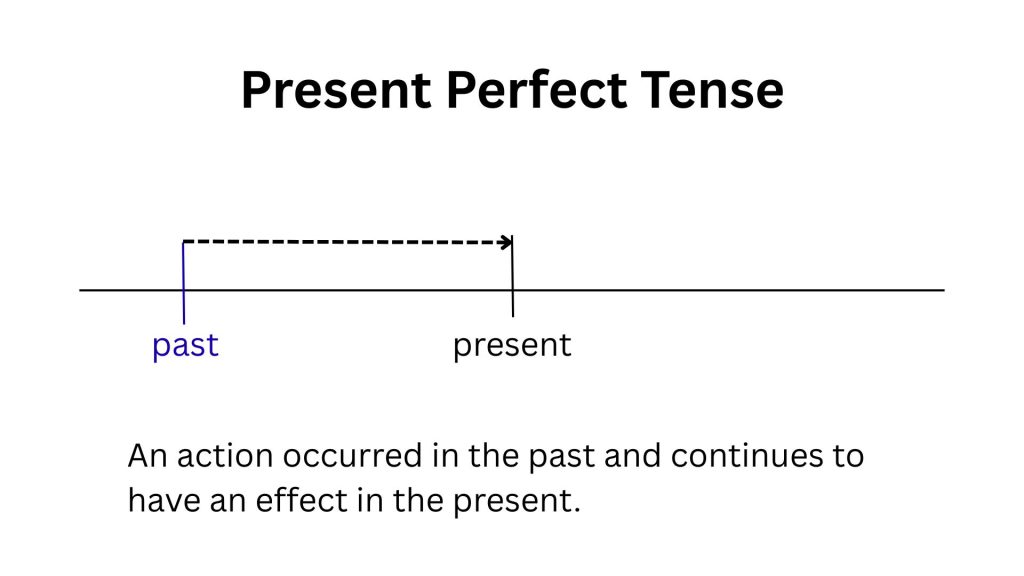
A useful way to understand the present perfect is this: it refers to something that happened in the past but still has relevance to the present. Unlike the simple past, it doesn’t simply present an action as a finished event in the past.
Here is an example of the present perfect:
I have studied TOEFL for three hours.
This sentence uses the present perfect rather than the simple past. It suggests that the action of studying began in the past and is still continuing now. We can understand that the speaker started studying TOEFL three hours ago and has continued up to the present moment.
As this example shows, the present perfect connects a past action or state to the present.
It is important to note, however, that the present perfect is often interpreted in three main ways: continuation, experience, and recent completion. All of these uses express a connection between the past and the present. Which interpretation is appropriate depends on the context, and this is one reason why the present perfect can seem difficult for learners.
Continuation
This is one of the clearest uses of the present perfect tense. The present perfect can be used when an action or state began in the past and has continued up to the present. You may understand this use more clearly by comparing the following two sentences.
I left the window open.
This simple past sentence shows that the speaker left the window open at some point in the past. The sentence presents that situation as a past event and doesn’t focus on whether the window is still open now.
I have left the window open.
By contrast, this present perfect sentence shows that the past action still has relevance to the present. It suggests that the window was left open in the past and remains open now.
Experience
The present perfect can also be used to talk about experience. This may seem slightly unusual at first. However, an experience from the past can still be relevant in the present because it remains part of a person’s life history.
For example, when you want to say that you have the experience of traveling to the United States, the present perfect is often more appropriate than the simple past.
I have been to the US.
Here, the present perfect is used to refer to experience. This is different from the simple past sentence below:
I went to the US.
The second sentence is in the simple past, so it presents the trip as a past event. By contrast, “I have been to the US” focuses on the fact that this experience is part of the speaker’s background now.
Recent Completion
Finally, the present perfect can also be used to refer to an action that has just been completed. This use is especially common in spoken English rather than written text. Let’s look at how it appears in a sentence.
I have finished my homework.
Compared with the simple past sentence, “I finished my homework,” the present perfect version suggests that the action was completed very recently and still has relevance to the present moment. In other words, the homework is now finished, and that completed result matters now.
Here’s another example:
She has just left the office.
In this sentence, the present perfect shows that the action happened a very short time ago. The word “just” makes the sense of recent completion even clearer. The sentence focuses not only on the past action itself but also on its immediate relevance to the present. For example, she is not in the office now.
Past Perfect
The past perfect is another major perfect form in English. It is formed with “had + past participle,” such as “had eaten” or “had walked.”
Like the present perfect, the past perfect shows a relationship between one time point and another. However, while the present perfect connects a past action to the present, the past perfect connects an earlier event to a later point in the past.
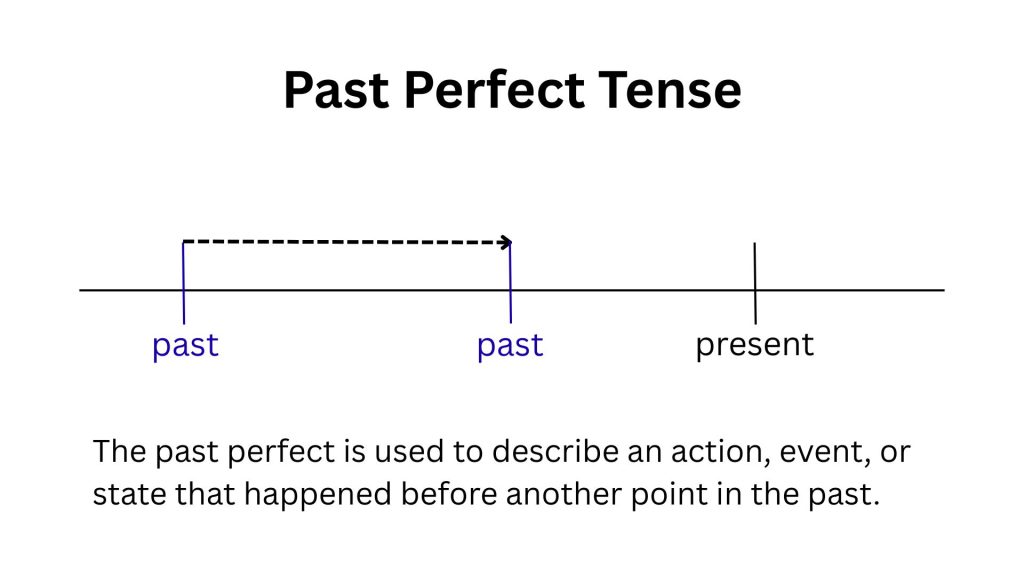
The past perfect is commonly used in the following situation:
- to describe an action, event, or state that happened before another point in the past
Compared with the present perfect, the past perfect is often easier to recognize because it usually appears in relation to another past event or past time reference. Now, let us look at how the past perfect is used in sentences.
Example Sentences with the Past Perfect Tense
I had lived in India before coming to the United Kingdom.
In this sentence, the past perfect is used to describe a state that existed before another point in the past. The speaker’s living in India came before the later action of moving to the UK.
This is a typical use of the past perfect: it shows that one past situation happened earlier than another past event.
Now consider the next sentence.
I realized that I had lost my wallet.
In this sentence, the past perfect is used in the clause “that I had lost my wallet” to show that losing the wallet happened before the moment of realization.
In other words, the sentence presents two past events, and the past perfect makes the earlier one clear.
Omitting the Past Perfect When the Timeline Is Clear from Other Words
In some cases, you don’t need to use the past perfect if the order of events is already made clear by another word or expression. In other words, when a sentence already shows which event happened first, the simple past may be enough.
Here’s an example sentence.
I lived in the US after spending 5 years in Japan.
In this sentence, the word “after” already shows the order of events. Because the timeline is clear, the sentence does not need the past perfect to indicate which event came first.
Here’s another example.
As soon as she finished her homework, she went to bed.
In this sentence, the expression “as soon as” clearly shows the sequence of events. Because the order is already clear, the simple past is enough.
Summary of the Simple Past and the Perfect Tenses
Finally, let us summarize the difference between the simple past, the present perfect, and the past perfect. Although all three can refer to the past, they differ in how they relate a past action, event, or state to another point in time.
The simple past presents an action, event, or state as a completed fact in the past. By contrast, the perfect tenses do more than simply place something in the past. They show a relationship between one past action, event, or state and another point in time.
The present perfect connects a past action, event, or state to the present. The past perfect shows that an action, event, or state happened before another point in the past.
| Tense | Example | Meaning |
|---|---|---|
| Simple Past | She lost her keys yesterday. | This is a finished past event. |
| Present Perfect | She has lost her keys. | She lost them in the past, and that matters now. |
| Past Perfect | She had lost her keys before she got home. | The loss happened earlier than another past event. |
